
A Complete List of Different Types of Ear Piercings
The Ultimate Guide to Different Types of Ear Piercings
The cultivated ear is one of the top piercing trends in the world. Characterised by many different types of ear piercings in the lobe and cartilage to create a unique piercing look, piercees of all ages seek it out. Because of the mainstream acceptability of all types of ear piercings, the cultivated cartilage look allows anyone to enjoy unique and interesting piercings without affecting their employability (for the most part).
Planning an ear piercing look with your clients can be a great way to ensure long-term business. Cultivated cartilage takes time, especially if they’re starting from scratch and want a bunch of different piercings. Here’s our guide to the various ear piercing types and how to plan a cultivated look with your customers.
A complete list of ear piercing types
The great thing about the ear is that it can be pierced pretty much anywhere. Although there are some types of ear piercings that require very specific anatomy, like the rook piercing, you can often create a piercing look that emulates the desired piercing, e.g. the faux rook.
Here’s a full list of different types of ear piercings.
Note: Everyone experiences piercing pain differently. The piercing pain levels we’ve listed note typical experiences, but you may get some clients who will feel nothing and others who feel intense pain for the same piercing. Additionally, we’ve provided common healing times, but they may be longer or shorter depending on your client’s ability to heal and adherence to aftercare. Encourage them to come to you to confirm that healing is complete before stopping aftercare practices, as piercings appear healed before the piercing tunnel has fully developed.
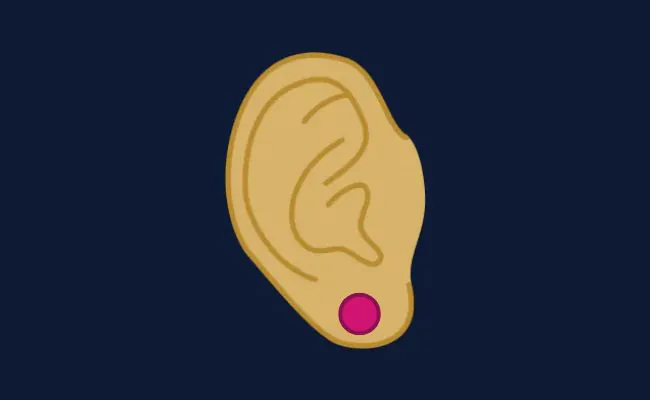
Lobe
The lobe piercing appears in—you guessed it—the lobe of the ear. Due to its low pain level and quick healing period, it’s the easiest ear piercing to get. Because the lobe can be pierced pretty much anywhere, it allows for a plethora of styles, like the triangle piercing—three piercings placed in a triangular formation—the stacked lobe—more about that below—and multiple lobe piercings.
Pain level: Very low
Healing time: 4 – 8 weeks
Jewellery: Earring studs, dangle earrings, hoops, straight barbells
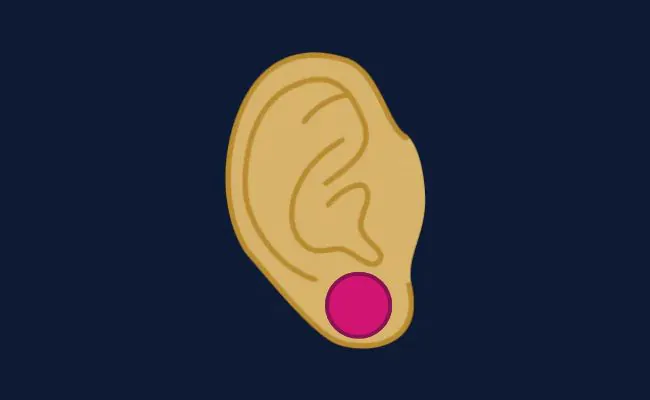
Stretched Lobe
Because the lobe tissue is pretty elastic, it can easily stretch to wear larger jewellery sizes. Although stretched lobes can be done at home, you should recommend that your clients come to you for consultation throughout the process, as complications can occur.
Pain level: Very low
Healing time: Wait until the piercing has healed for 4 – 6 months after getting pierced and stretch no more than one gauge every 2 – 3 months.
Jewellery: Plugs and tunnels

High lobe
As the name implies, the high lobe piercing appears in the upper lobe, near where the soft, fleshy tissue transitions into cartilage. This goes well with different types of ear piercings, as it acts as a transition between the cartilage and the lobe.
Pain level: Very low
Healing time: 4 – 8 weeks
Jewellery: Earring studs, dangle earrings, hoops, straight barbells, etc.
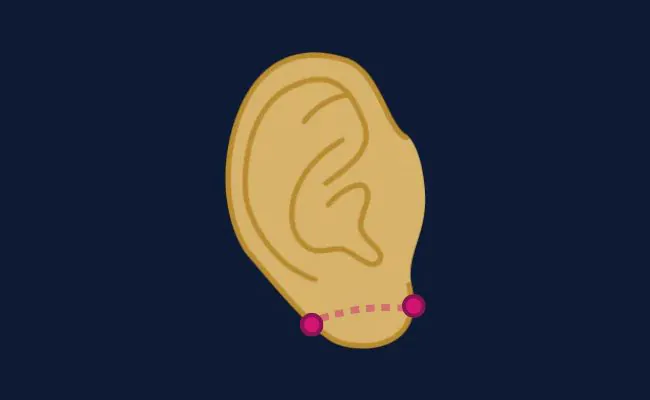
Transverse lobe
This unique piercing is a great option for those who want something truly distinct. The piercing tunnel goes across the earlobe instead of front to back, allowing the two bead ends of the jewellery to decorate the very bottom of the lobe. Although the transverse lobe can heal fairly quickly, the long piercing tunnel causes a lengthy healing period for some people.
Pain level: Low
Healing time: 2 – 10 months
Jewellery: Curved barbell
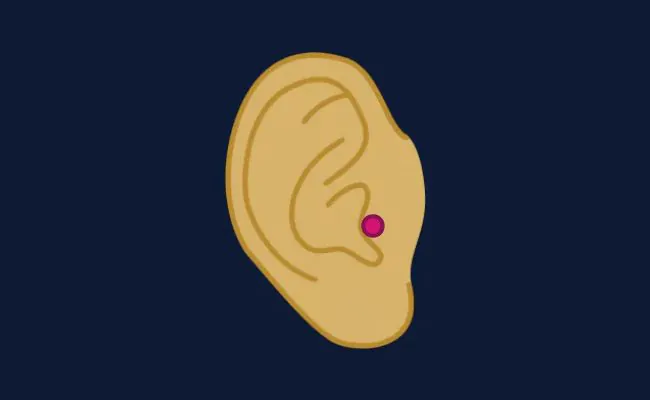
Tragus
The tragus piercing appears in the triangular flap of cartilage in front of the ear canal. It’s the cartilage piece that people often use to plug their ears from loud noises. As a super dainty piercing, it’s gained popularity recently for its subtle but exceptional look.
Pain level: Medium, Medium-Low
Healing time: 6 – 9 months+
Jewellery: Flat-back earring, hoop, horseshoe, or straight barbell
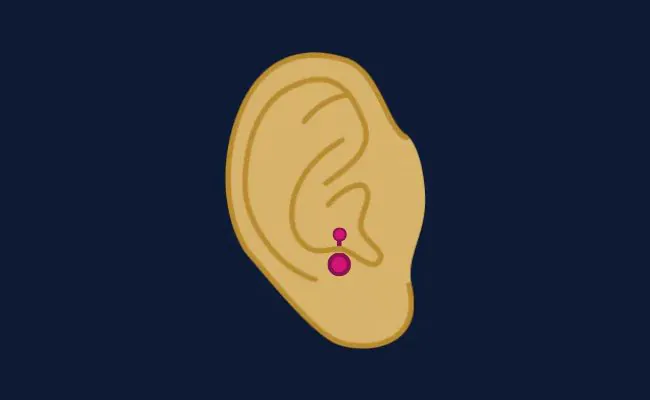
Anti-tragus
If you pinch your lobe, you should feel a tiny triangle of cartilage at the very top, which sits almost opposite to the tragus. That’s your anti-tragus. The anti-tragus is another ear piercing that’s gaining some popularity for its uniqueness; combined with multiple lobe piercings, it creates an eye-catching aesthetic.
Pain level: Medium, Medium-High
Healing time: 6 – 9 months+
Jewellery: Flat-back earring, hoop, straight barbell, horseshoe, or curved barbell
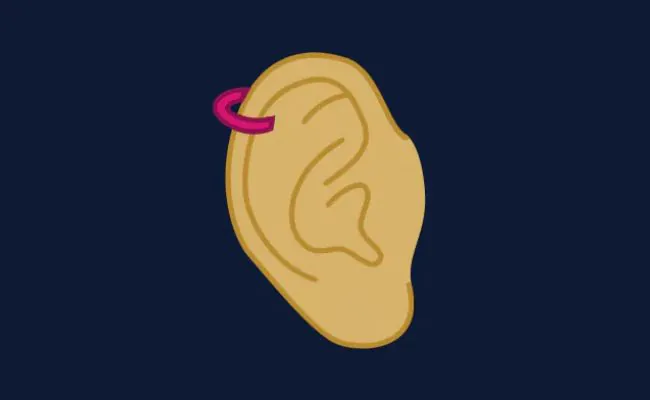
Helix
One of the most popular ear piercing types, and probably the least painful cartilage piercing, the helix piercing traditionally appears in the outer rim of the ear close to the apex. However, terminology for this piercing varies, and some people may refer to this piercing location as just a cartilage piercing. It’s common to get a row of two, three, and even four helix piercings.
Pain level: Medium, Medium-Low
Healing time: 6 – 9 months+
Jewellery: Straight barbells, flat-back earrings, horseshoes, or hoops
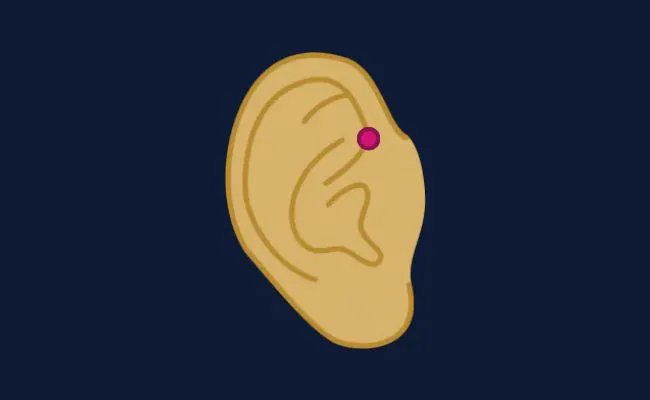
Forward helix
The forward helix piercing, aka anti-helix piercing, appears on the inner rim of the ear near the head. Because it’s located in such a tight area, it’s decorated with super dainty jewellery, which creates a subtle but sophisticated style.
Pain level: Medium, Medium-Low
Healing time: 6 – 9 months+
Jewellery: Flat-back earrings, horseshoes, or hoops
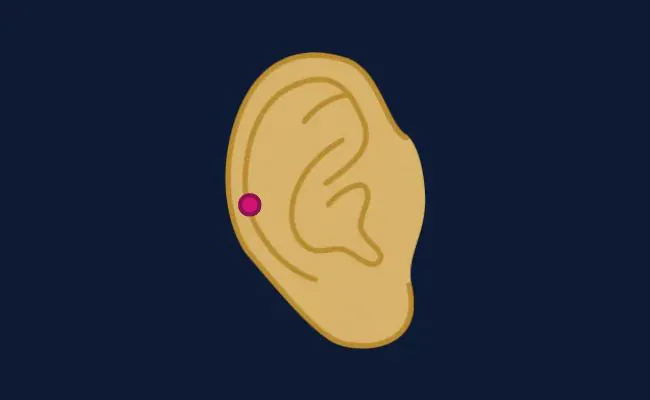
Auricle
The auricle piercing appears along the rim of the ear, about halfway between the lobe and the apex. Since it’s placed on the rim of the ear, people will sometimes refer to it as a helix, so be aware of this when discussing piercing placement with your customers. Furthermore, it could get in the way of other ear piercing types, like a conch filled with a large hoop or a snug piercing, so you should discuss any future piercing plans with your client before doing this piercing.
Pain level: Medium, Medium-Low
Healing time: 6 – 9 months+
Jewellery: Straight barbells, flat-back earrings, horseshoes, or hoops
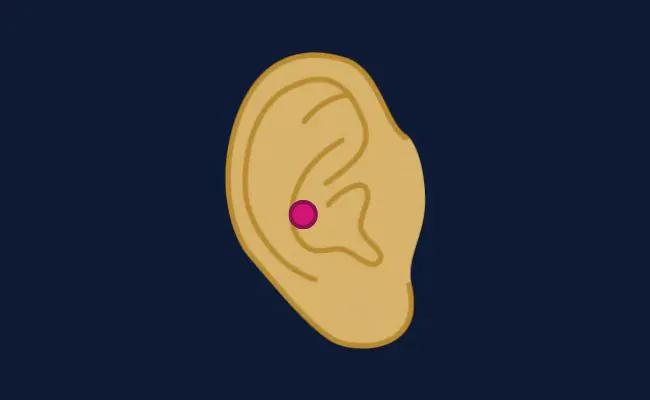
Conch
Named for the seashell, the conch piercing appears in the spiral-shaped inner cartilage of the ear. It has gained popularity for its distinct look and location and does a great job of offsetting other piercing types. When exploring different types of ear piercings, the conch might be just what your customers are looking for.
Pain level: Medium-High
Healing time: 6 – 9 months+
Jewellery: Straight barbells, flat-back studs, large hoops, and horseshoes
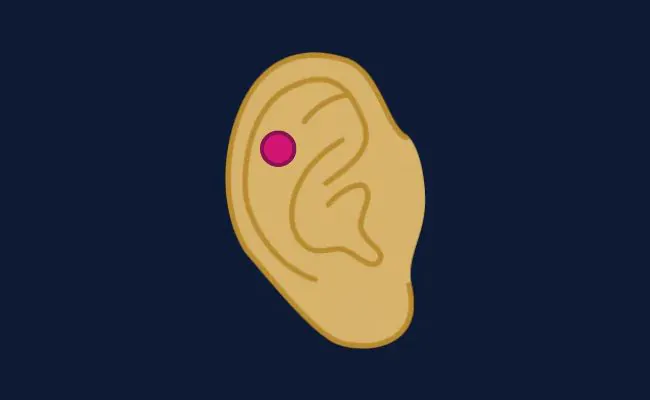
Flat
The flat piercing, also known as a flat helix piercing, appears in the flat cartilage at the top of the ear below the helix. This is an excellent piercing location because it offers a vast canvas; you can get pierced pretty much anywhere. People often get multiple flat piercings, snake eyes, or triangle piercings in this location. We talk more about these below.
Pain level: Medium-High, High
Healing time: 6 – 9 months+
Jewellery: Flat-back earrings or straight barbells
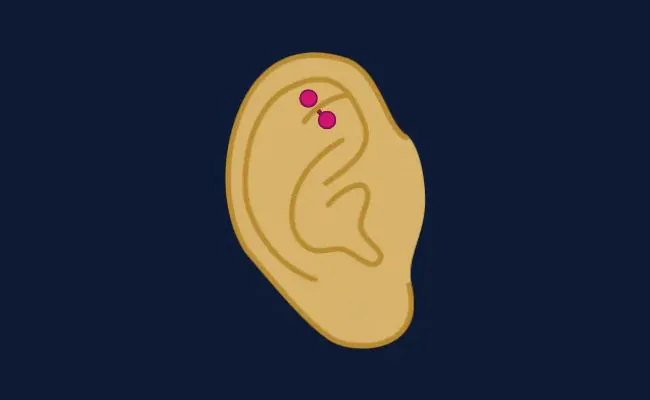
Rook
Below the flat piercing area and near the forward helix area, most people have a fold of cartilage. This is where the rook piercing appears. Although a successful rook piercing creates an enviable look, very few people have suitable anatomy to get this piercing type, as the cartilage fold needs to be pronounced. Luckily, a faux rook piercing can create a similar aesthetic.
Pain level: Medium-High
Healing time: 6 – 9 months+
Jewellery: Hoop, horseshoe, or curved barbell

Faux rook
If your client doesn’t have the suitable anatomy for a rook piercing, the faux rook creates a similar look that almost anyone can get. It can be done two different ways: with a single piercing above the flap of cartilage where the rook would appear or with a double piercing with one hole appearing above the rook and one appearing below it. The latter is more true to the rook look, but it requires aftercare for two piercings at once, which some clients might not want to do.
Pain level: Medium
Healing time: 6 – 9 months+
Jewellery: Flat-back earrings
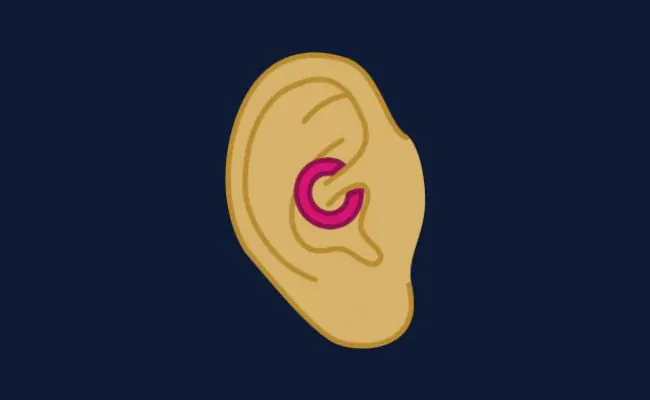
Daith
The daith piercing pierces the fold of cartilage right above the ear canal. Although it can be decorated with dainty jewellery, many people choose to wear elaborate hoops, which beautifully decorate the inner ear. This can be a great way to create a centerpiece for a cultivated ear piercing look.
Pain level: Medium, Medium-Low
Healing time: 6 – 9 months+
Jewellery: Hoops or horseshoes

Snug
The snug piercing is another piercing that looks amazing, but few carry the suitable anatomy to get one successfully. It’s a front-facing piercing that appears in the fold of cartilage just inside the rim of the ear near where the auricle is located. Filled with a dainty curved barbell, the snug piercing is perhaps one of the most alluring types of ear piercings, if only for its rarity.
Pain level: Medium-High, High
Healing time: 6 – 9 months+
Jewellery: Curved barbells
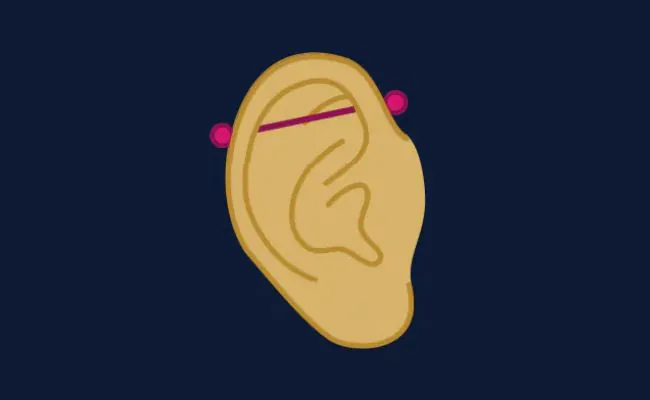
Industrial piercing
Characterised by two different piercings in the helix and forward helix of the ear and connected with a single piece of jewellery, the industrial piercing has been a piercing favourite for years. It’s a great way to decorate the upper cartilage of the ear in a bold and unique way. Another benefit of the industrial piercing is that, since it’s made up of two different piercings, the piercee can choose whether they want to wear the industrial look or simply fill them with standard ear piercing jewellery. Because they constitute two piercings, the healing period and piercing process can be challenging, so they may not be for everyone.
Pain level: Medium-High, High
Healing time: 6 – 9 months+
Jewellery: Industrial barbells, long straight barbells
Ear piercing trends
Besides the various types of ear piercings, there are a few piercing trends that can be worn in different areas of the ear.

Snake bite
Although “snake bite” usually refers to a type of lip piercing, it also describes two ear piercings placed close to each other to resemble a snake bite.
Common locations include the flat, forward helix, lobe, or auricle regions. Decorated with small gemstones, this can be an excellent addition to many cartilage looks.
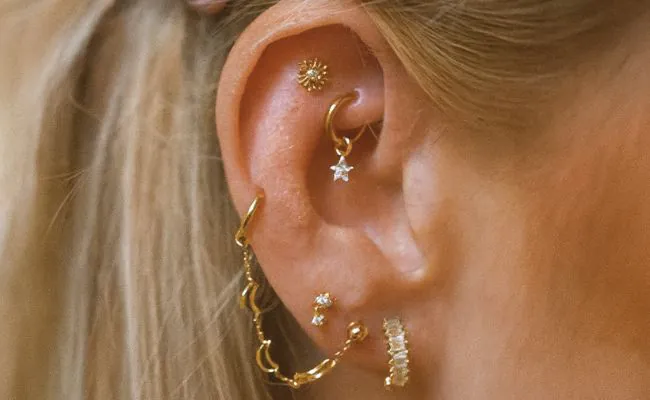
Constellation piercings
Astrology enthusiasts have popularised constellation piercings—when all types of ear piercings are planned in a way so that they resemble a specific star sign. This can be a challenging but fun look, as you’ll have to be creative with placing the piercings with each customer’s unique anatomy.
These are best done with virgin ears, as existing piercings can cause additional placement difficulties.

Triangle piercings
Similar to snake bite piercings, triangle piercings are three separate piercings placed closely together in a triangle shape. Common locations for this style are the lobe, flat, and conch.
If your client doesn’t want to deal with healing three different piercings, you can also recommend triangle-shaped ear piercing jewellery instead.
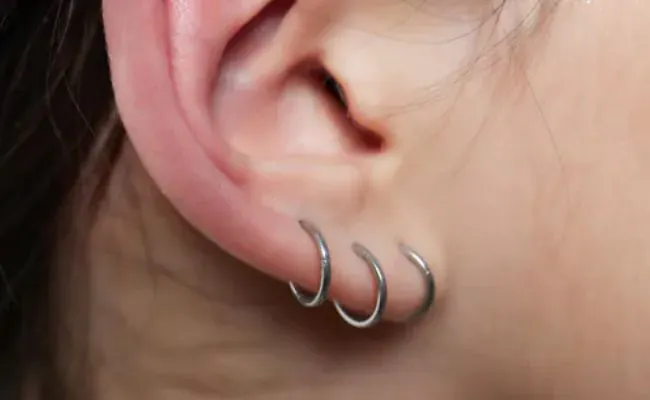
Stacked lobe
Stacked lobe piercings refer to multiple lobe piercings. While they sometimes appear on top of each other, a stacked lobe look can also refer to a line of lobe piercings or any other multiple lobe piercing look.
This aesthetic is great for those who want to have different types of ear piercings without the lengthy healing period of cartilage piercings.
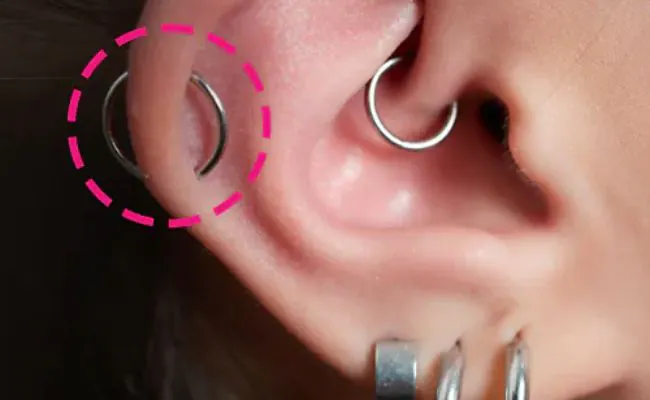
Orbital piercings
Technically, orbital piercings refer to any two piercings connected using a hoop. This creates an amazing aesthetic, typically in the lobe.
It’s important to note that the term “orbital piercing” has also come to refer to a conch piercing filled with a large hoop that goes around the rim of the ear. Although this terminology is incorrect, you’ll likely have many clients who will ask for an orbital piercing and mean a conch.
How to plan the cultivated ear
Although many customers will curate their ear piercing look piercing by piercing, other more forward-thinking clients will want to have their style planned in advance. This can be an excellent way to guarantee future business. Consider offering specific services to help your clients plan and build the cultivated ear of their dreams.
While it is possible to get different types of ear piercings at once, most piercers don’t recommend getting more than three at a time, especially considering cartilage piercings’ long healing times. When determining how many piercings your client can get at once, have a frank discussion about aftercare practices and how well they adhere to them. If they admit that they aren’t the most responsible when it comes to cleaning their piercing, only conduct one piercing at a time.
Cartilage piercing risks and considerations
Although the lobe piercing is pretty easy to care for, cartilage piercings carry more risks and difficulties. Because they take so long to heal, they are more susceptible to issues like piercing bumps, infections, and damage. Much of this is since people stop aftercare practices before their piercing has fully healed. After a few months, the piercing seems healed, so they stop cleaning it, even though the piercing tunnel hasn’t fully closed internally.
After conducting a cartilage piercing, make sure that your client is aware that they need to care for their piercing for many months, and encourage them to have you inspect the piercing and confirm when it has healed before they stop aftercare practices.
Cartilage bumps
Piercing bumps are one of the most common problems when healing a cartilage piercing. There are a myriad of cartilage bumps that appear for various reasons. Encourage your clients to consult with you if one should appear. The internet is full of misinformation regarding cartilage bumps, and self-treatment can often worsen the issue.

Here are some of the most common issues related to cartilage piercings:
- Scarring: Many bumps form as the result of scarring due to a disruption in healing. This can be due to friction on the piercing site, dampness, moving the jewellery around too much, or using improper aftercare products. To fix this, simply identify what’s causing the healing disruption, remove it, and give the bump time to go away.
- Granulation tissue: If a hard bump forms, it may be granulation tissue. This is when extra tissue grows around the piercing site as it heals. Typically, a doctor will need to remove this type of bump.
- Pustules: These are essentially little pimples that appear near the piercing site. Pustules can be treated by using a warm compress to drain and heal the bump. These should never be popped, as it can make the problem worse.
- Allergies: If the client has a nickel or other metal allergy, rashy bumps may appear. In this case, you should change the jewellery to a hypo-allergenic material, and the bumps should go away. Titanium is the best option for sensitive skin.
- Keloids: These are actually incredibly rare, but the term “keloid” is now incorrectly synonymous with “cartilage bump,” so they’re worth mentioning here. Keloids are a genetic skin condition that affects any wound. They are characterised by large, pink or brown lumps that appear on or near the piercing site, and they won’t go away on their own. If your client has never developed a keloid before, it’s unlikely that they’ll develop one on their cartilage piercing.
Ear piercing aftercare
Regardless of the ear piercing types, aftercare practices will always be the same. Your client should make it a habit to clean their ear piercing 2 – 3 times daily with a piercing aftercare saline solution.
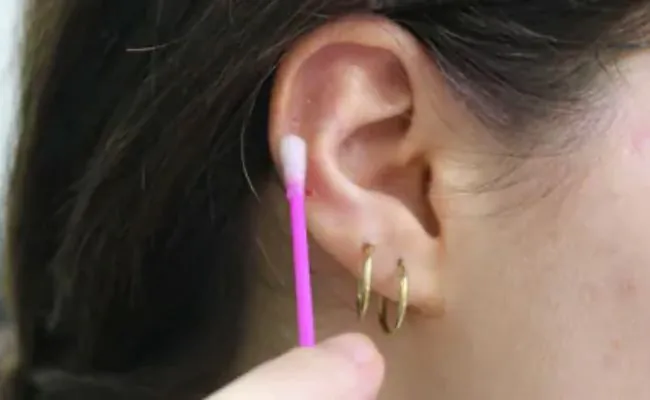
This can be done as follows, in a number of different ways:
- Spray the entry and exit holes of the piercing directly with the solution.
- Spray a clean paper towel with piercing aftercare saline solution and gently clean the front and back of the piercing.
- Fill a small cup with saline solution and dip the piercing into the solution for 3 – 5 minutes. Gently dry with a clean paper towel once complete. This may be the preferred method for the transverse lobe piercing, as it helps clean the long piercing tunnel.
Here are some tips for successful healing to pass along to your clients:
- Keep the piercing dry. Do not take baths, and when you get out of the shower, gently dry your piercing with a clean paper towel as soon as possible.
- Avoid swimming pools, hot tubs, lakes, and other bodies of water.
- Only use piercing aftercare saline solution on or around the piercing. Avoid things like alcohol, lotion, shampoo, soap, and other products as these can be irritating to the piercing.
- Keep the jewellery as still as possible, and protect the piercing from snagging.
- Do not wear hats or headphones that press against the piercing.
- Do not sleep on the piercing. If you prefer to sleep on your side, get a travel pillow and rest your ear in the hole so that you can lay down without placing pressure on it.
- Do not twist the jewellery.
- Do not pick at any crusties that form. Instead, you can gently dab them away with a clean paper towel soaked in saline solution or purified water.
Quality ear piercing jewellery
Set your customers up for success with quality piercing jewellery for both fresh and healed piercings.
Fresh piercings can only handle certain jewellery materials. Although there are various suitable jewellery material options, 316L surgical steel and G23 titanium are recommended. Both are inexpensive, lightweight, and hypoallergenic, making them ideal choices. You can also use 14k or 18k gold in fresh piercings, but as they are more expensive, most people wait until their piercings have fully healed before investing in such pieces.
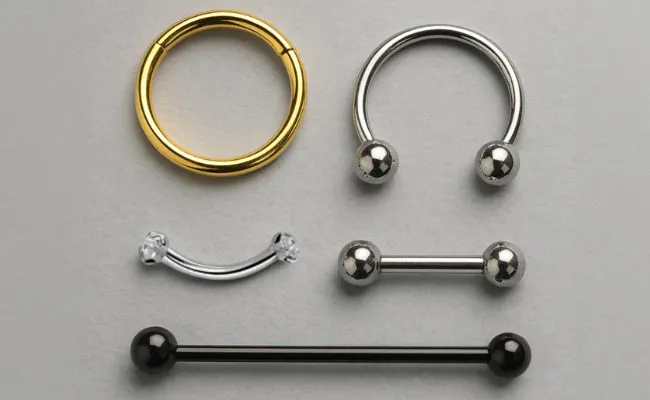
If the jewellery is threaded, it should either be internally threaded or threadless. Even though the threading is small, externally threaded jewellery can cause some damage as it enters a fresh piercing.
All types of ear piercings should also wear simple jewellery pieces as the piercing heals. Elaborate designs carry more weight, which could pull against the piercing holes and prolong healing.
Once the different types of ear piercings have healed, they can wear all sorts of designs. Make sure that your studio stands out by offering a wide range of styles that your customers can’t find anywhere else.
Here at Acha, we have plenty of ear piercing jewellery options for fresh and healed piercings, including individually packaged, EO gas sterilised jewellery and piercing tools. Our jewellery selection enjoys the highest standards of quality control, material certifications, and everything you need to import into the UK. We have been trusted by customers in the UK and all over the world for over two decades. Ready to learn more? Contact us today.
Publication date and/or Last Updated: January 16, 2025
Author: cesar@suprank.com
Views: 537
Copyright Holder: Acha Co., Ltd.
Company info: WholesaleBodyJewellery is owned and operated by Acha, a leading manufacturer and online supplier of piercing jewellery with more than 20 years in the industry.


