
Two Piercings in One: The Piercer’s Guide to Industrial Piercings
Two Piercings in One: The Piercer’s Guide to Industrial Piercings
The industrial piercing is one of those styles that makes people stop and say, “I want that!” It creates an asymmetry in the ear that transforms any cultivated cartilage look, and it can be an absolute showstopper when filled with the right industrial jewellery.
Because it consists of two separate piercings in the cartilage of the ear—an area that’s notoriously difficult to heal—it comes with its complications. As a piercer, it’s your responsibility to not only conduct this piercing correctly but also provide ample support during healing and ensure that your client has the tools they need to heal the piercing safely.
Here’s our complete guide to industrial ear piercings and where to find industrial piercing jewellery your customers will love.
What are industrial piercings?
Industrial piercings refer to any two piercings connected with a single straight barbell. Traditionally, they’re placed in the upper rim of the ear, connecting piercings in the forward helix and standard helix areas. However, this isn’t the only placement that you can try. Other figurations pass through the upper and lower conch—sometimes referred to as the vertical industrial—or through the tragus and the conch.

Industrial piercings can be done anywhere as long as suitable industrial piercing anatomy exists. Unfortunately, many people’s ear cartilage doesn’t have adequate structure to support such a piercing. The cartilage needs to be thick enough to hold the jewellery without too much stress on the tissue, and it needs to be the proper shape; ears that have too many ridges do not do well with an industrial piercing. This sometimes requires bending the jewellery so that it can fit where you need it to go.
Although it might not seem like it, industrial piercings take a high level of skill to perform. Spend ample time learning how to perfect this craft. If you’re known as someone who can do an industrial bar piercing well, it could be a lucrative specialisation.
Industrial piercing process
The first thing you should do is ensure that your client is prepared to deal with the long, somewhat arduous healing period. If they cannot commit to aftercare practices for the entire healing period, then you can guide them toward a piercing with a shorter healing time.

Next, determine is whether your client has suitable Industrial piercing anatomy. This is an incredibly important step, as industrial bar piercings are known for their difficult healing. Not only must the cartilage have the structure to support an industrial bar, but the surrounding tissue must also be able to accommodate the jewellery. If the angles of the two piercings don’t line up, it could place pressure on the piercings. This may lead to discomfort and healing complications.
In some cases, you may be able to bend industrial piercing jewellery slightly to get it to fit the way you want it to. However, you must have the proper equipment to do so. When bending the jewellery, you must be careful not to create any scratches or burrs, and it’s recommended that you repolish the piece to bring it back to a mirror shine. Do not bend the jewellery if you don’t have experience doing so.
One technique to help you line up the piercing holes is to keep the needle in the first piercing so that you can direct the angle of the subsequent piercing. Getting these lined up is essential to piercing success. If it’s even slightly off, the jewellery could cause trauma to the piercing site.
How much do industrial piercings hurt?
As with every piercing, Industrial piercing pain varies from person to person. Most place it somewhere between 7-8/10 on the pain scale, but some say that it’s closer to a 5-6/10. The biggest pain factor is that industrial piercings require two piercings at once, which may be uncomfortable for some. Unfortunately, due to the necessity that the piercings be impeccably lined up, you have to do both in one sitting. If you do one at a time, there’s a chance that the piercings won’t line up properly.
Aftercare and healing
Sometimes, it’s helpful for clients to know and understand industrial piercing healing stages so they know what to expect. It’s important to note that the time frames for each phase are not exact and will vary from person to person.
The first week or so is the initial healing period, also known as the inflammatory phase. This will be when they experience the most discomfort. The piercing will likely swell, and there may be some throbbing pain. This is all normal.
After the initial healing ends, the main portion of the aftercare period begins. The proliferative stage is when the inside of the piercing is healing itself from the outside in. It can last up to one year. During this stage, crusties are apt to form. These are a standard part of healing. Once this stage is done, aftercare practices can end.
Once the piercing tunnel heals, there’s still one last stage: maturation. This is when the tissue strengthens internally, and it can take years. Even though the piercee won’t have to participate in aftercare practices during this time, they should still be aware that the piercing is delicate and avoid trauma as much as possible.
Like other cartilage piercings, industrial ear piercings take a minimum of 6 – 9 months to heal, with some taking a year or more. Many people have a difficult time with the extensive healing period, so make sure that they’re prepared to adhere to aftercare for as long as a year. Have your clients come to you to confirm that healing is complete before stopping aftercare practices.
Aftercare rules
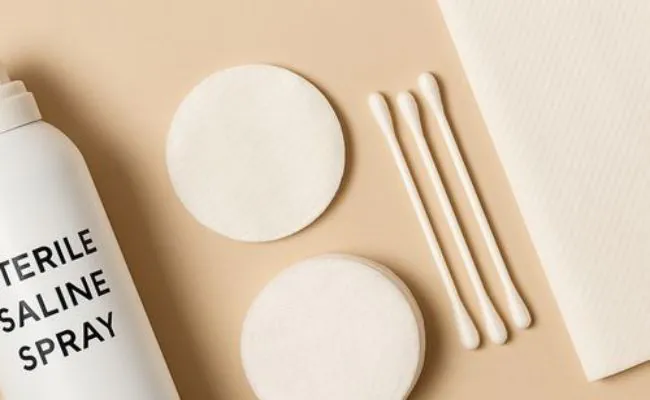
Throughout the entire healing period, your clients must clean their industrial piercings 2 – 3 times daily with a piercing aftercare saline solution. This solution should only contain salt and water as additional ingredients may cause irritation.
To clean the piercing, they can try a few different methods, depending on preference:
- Spray the front and back of each piercing with saline and let it air dry.
- Wet a clean paper towel with saline solution and gently wipe the front and back of each piercing.
- Make a saline compress and hold the saline-soaked paper towel to each piercing for a couple of minutes. Warm or cold compresses can help alleviate pain during the initial healing stages.
Besides cleaning the piercing every day, you can impart some aftercare rules:
- Do not sleep on the industrial bar piercing. If you must sleep on your side, invest in a travel pillow, and place your ear in the hole as you rest.
- Do not place pressure on the industrial piercing jewellery. This means avoiding hats, certain hairstyles, headphones, and anything else that might touch the piercing during healing.
- While some pain during the first few days after getting pierced is normal, it shouldn’t last too long. If you feel like the jewellery is pressing against the piercing holes, have your piercer take a look to make sure that everything is healing correctly.
- Do not touch or twist the jewellery, and do not remove or change the jewellery until your piercer says it’s okay..
- Keep away from hot tubs, baths, swimming pools, and anything that might get the piercing wet.
- Keep the piercing as dry as possible. Make sure to dab it dry immediately after showering or after working out.
- Do not pick at any crusties that form. Instead, wet a paper towel with purified water and gently dab them away.
- Take care of snags. If you experience a bad snag or tug, have your piercer check to make sure that everything is okay. Since this consists of two carefully aligned piercings, a bad tear could cause some issues.
- Avoid any product that’s not piercing aftercare saline solution, including sunscreen, lotion, makeup, antibiotics, and creams.
- Keep hair away from the piercing to avoid snags. Consider wearing your hair up, especially during the first few days of healing.
Risks and complications
Industrial piercings are particularly difficult to heal due to the fact that they’re two separate piercings. Not only is there the challenge of healing two piercings at once, but the barbell that connects them may tend to move, leading to issues like piercing bumps and prolonged healing.

You must impart the importance of avoiding trauma and keeping the jewellery still during healing. You should also make yourself available for aftercare consultation and encourage them to come to you if they suspect something is wrong.
Piercing bumps
Industrial piercings tend to get piercing bumps more than other piercing types. This is because it requires precise placement, and the long barbell connecting the two piercings can easily snag. If your clients have had difficulties healing piercings in the past, then you may guide them toward a different piercing choice.
Here are the most common types of piercing bumps:
- Hypertrophic granulation: These usually arise due to trauma to the piercing site and can be common in industrial piercings. Characterised as a red, raised bump on or near the piercing site, it occurs due to too much collagen production. They’ll usually go away on their own, but if the jewellery is placed at a poor angle, they might not go away until the piercing is retired.
- Pustules: These are small, pimple-like bumps that appear around the piercing. They may be painful, and they can spread if not dealt with. They can be healed by keeping the piercing clean and dry.
- Irritation/allergies: These rash-like bumps usually arise because of poor jewellery materials or exposure to products like shampoo or lotion. They can be healed by avoiding the irritant.
Infection
Infections aren’t super common as long as the piercee cleans their piercing properly, but they can happen even if they do everything right. Symptoms of infection include inflammation, heat around the piercing site, swelling, green or yellow discharge, and throbbing pain. Often, these symptoms arise rapidly. If your clients suspect an infection, they must visit a medical professional immediately for treatment.
Industrial piercing jewellery
Now that we’re done with the nitty gritty, it’s time for the fun part: jewellery.
For initial piercings, there are only a few suitable jewellery materials that can be worn. The most common are 316L surgical steel and titanium G23. Both are hypoallergenic, noncorrosive, and lightweight (although titanium weighs less than surgical steel). The key difference is that surgical steel contains trace amounts of nickel while titanium has none. Therefore, titanium has become a more popular choice, especially for those with sensitive skin.
Industrial piercings are typically pierced at 14G or 16G. The length of the jewellery depends upon the piercing placement and anatomy of the ear.
14k and 18k gold are also suitable materials for fresh piercings. However, they are more expensive, which is why most people choose to wait until the piercing has successfully healed before making such an investment.
Once the piercing has fully healed, industrial jewellery options widen. Although any straight barbell can be worn in an industrial bar piercing, there are industrial bars with decorations at the center of the jewellery that many people love. Check out industrial jewellery with dangling stars, spiked balls, long chains connecting the two piercings, and more.
Keep in mind, if you had to bend the jewellery to fit your client, they will need to continue to buy custom-fit jewellery. Even after the piercing has healed, piercing bumps can still form if they wear the wrong jewellery shape. Remember, the maturation healing phase can last for years after getting pierced, and if the jewellery presses too hard against the piercings, it could cause issues.
The best part about industrial ear piercings is that, once the piercings have healed, they can wear other jewellery types besides the industrial bar. Dainty earrings, hoops, and circulars look fantastic on days when the piercee isn’t feeling the industrial aesthetic.
Shop wholesale industrial jewellery in the UK
Such a versatile piercing begs for versatile jewellery. Luckily, we’ve got thousands of items to choose from at affordable prices.
Whether you’re looking for high-quality industrial piercing jewellery or various cartilage earrings, we’ve got you covered. We’ve partnered with many studios across the UK for over 20 years, so we not only understand the styles you want but the ins and outs of piercing safety, too. We’ll take care of the compliance and importation; all you have to do is choose the jewellery styles your clients are sure to love.
We offer a wide range of jewellery options, including internally threaded and threadless pieces and individually packaged, EO-gas sterilised options. Quality and safety are our top priorities, and you can feel more than secure in our offerings.
For a huge industrial jewellery selection that you can’t find anywhere else, look no further. Interested in learning more? Contact us today!
Publication date and/or Last Updated: July 26, 2025
Author: cesar@suprank.com
Views: 533
Copyright Holder: Acha Co., Ltd.
Company info: WholesaleBodyJewellery is owned and operated by Acha, a leading manufacturer and online supplier of piercing jewellery with more than 20 years in the industry.


