
The Piercer’s Guide to Navel Piercings: Common Questions Answered
The Piercer’s Guide to Navel Piercings: Common Questions Answered
Now that we’re fully into spring, you’re sure to get quite a few questions about the belly button piercing. It makes sense; nothing goes better with a bikini or swimming costume than a sparkle of jewellery on the belly. Unfortunately, getting a navel piercing isn’t straightforward, and the lengthy healing period makes it one of the more difficult piercings to deal with.
Here are some questions about the belly piercing you might get and how to answer them.
What is a navel piercing?
A navel piercing, also referred to as a belly button piercing, is a piercing that appears in the tissue around the belly button. Traditionally, belly button piercings are placed in the skin above the belly button, with the bottom part of the jewellery sitting within the navel. However, there are a few alternatives to the standard belly piercing, including the bottom (or inverse) belly button piercing, which pierces the skin below the navel, the double belly button piercing, which consists of two belly piercings that appear in the skin above and below the navel, and the surface belly button piercing, which is done horizontally above or below the navel.
No matter the navel piercing style, belly button jewellery is usually a curved barbell or belly bar, but it can also wear hoops or twisted barbells once the piercing has healed. For the standard belly button piercing, it’s common to wear a curved barbell with a bottom attachment that’s slightly bigger than the top attachment. Wearers can also choose dangle styles, which have a dangly piece that drapes out of the navel, creating a bold and alluring look.
Because the navel piercing is so popular, any piercing studio should be sure to carry plenty of belly button jewellery options for your clients to choose from. Read on to learn more about our wholesale selection.
How long do navel piercings take to heal?
The navel piercing and all its variants will take a minimum of 6 – 9 months to heal. The lengthy healing period is due to its long piercing tunnel and location. Since it’s located on the belly, it sees a lot of movement throughout the day, and the long piercing tunnel takes longer to heal than, say, a lip piercing, which has a much shorter tunnel.

When your clients request a navel piercing, make sure they are aware of the long healing period before committing to it.
Many people will seek the navel piercing in the spring or late winter, looking forward to showing it off when summer hits. However, this will not give the navel piercing enough time to heal, and they’ll have to avoid beaches and water activities during the healing period. So, if your client asks, “How long does a belly button piercing take to heal?” you should also ask them about their summer plans and whether they need to wait to get pierced.
If they cannot commit to the healing period, you can recommend a fake belly button piercing jewellery. Stocking up on these items ensures that you can still make a sale even if your client decides not to move forward with the piercing. Learn more about our fake belly button piercing jewellery below.
How to clean a navel piercing
Cleaning a belly button piercing is similar to any other piercing. There are a few different ways you can recommend, depending on your preference. In all three methods, you should suggest using a piercing aftercare saline solution that only contains salt and water.

Some piercing aftercare solutions have tea tree oil or other additives that can irritate a fresh piercing, so careful attention to the ingredients must be paid.
Although it is possible to mix your own saline solution at home, it’s inadvisable to do this, as it’s too easy to get the salt-to-water ratio wrong.
Here’s how to clean a belly button piercing.
- Spray a clean paper towel with saline solution, and gently wipe the entry and exit holes.
- Spray the entry and exit holes directly with saline solution.
- Fill a small cup—such as a shot glass—with saline solution, and soak the piercing for 3 – 5 minutes. Then, gently pat the piercing dry.
Whichever method you choose to recommend, have your clients clean their belly button piercings 2 – 3 times daily until you have confirmed that their piercing has fully healed.
How to take care of navel piercings
Although keeping the belly button piercing clean at all times is one of the most important aspects of aftercare, it’s definitely not the only thing to pay attention to.
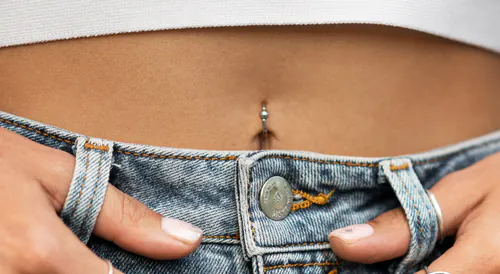
To avoid common complication that can occur with belly button piercings, such as bacterial infections, scarring, tearing or even the rejection of the belly button piercing, instruct your clients to do the following.
How To Take Care Of Navel Piercings
- Avoid water such as pools, hot tubs, baths, and so on. Dampness can cause issues like piercing bumps or infections, so the piercing needs to stay as dry as possible throughout the healing period. After you shower, be sure to pat the piercing dry with a clean paper towel as soon as you get out.
- Be cautious with the waistband of your clothing. It should not press against the piercing. Make sure that it sits either above or below the piercing. In general, piercees should wear looser clothing that doesn't press against or snag the piercing. While some piercers may recommend covering the piercing with a proactive bandage, others argue that this can cause problems as it makes the piercee sweat and the piercing damp.
- Do not pick at crusties that form around the piercing. Although these are natural parts of healing, they can be quite annoying. Instead, use a wet paper towel to dampen them and gently dab them away.
- Do not stop aftercare practices until a piercer has confirmed that it's fully healed. It will appeared healed on the outside before it's healed internally, and it takes an expert eye to ascertain whether it's fully healed or not.
- Do not use any products besides piercing aftercare saline solution on the piercing until it has fully healed. This includes sunscreen. To prevent sunburn, keep the piercing covered or stay out of the sun.
- Do not move or change the jewellery until it has fully healed. In the past, it was taught that piercing jewellery should be regularly twisted so that the skin doesn't grow onto the jewellery. This has since proven to be harmful to the piercing. Instead, you have to keep the jewellery as still as possible. If you need to change your belly button jewellery before the piercing has healed, have your piercer do it for you.
- Wear proper jewellery during the healing period. Until the piercing is fully healed, you should stick to a standard belly ring that's made of ASTM F-136 titanium or 316L surgical steel. It should be new jewellery that's free from knicks or dents, as these can harbour dirt and debris. It should also be internally threaded or contain no
Navel piercing risks and considerations
Navel piercings share the same risks as most other types of piercings. Since they are part of the surface piercing family, they tend to see migration and rejection a lot more than other piercings.
Because of this, wearers of belly button jewellery need to be particularly careful to keep the piercing still and safe from snags throughout the entire healing period.

Here are some of the biggest piercing risks and how to avoid them.
- Rejected belly button piercings: Navel piercings are typically rejected after a bad snag, if the wearer has improper anatomy for the navel piercing, if it was pierced incorrectly, or simply due to bad luck. Signs of migration and rejection include enlarged piercing holes, jewellery that’s moved, or red, tight, flaky, or transparent skin around the piercing site. Although rejection usually occurs during the healing period, it can arise at any time, so piercees need to be aware of the signs so that they can avoid a belly button piercing scar. To avoid rejection, piercees should keep their piercing safe from snags and tears.
- Infected belly button piercings: In general, true piercing infections are rare as long as the piercee cleans it daily and practices good hygiene. However, they can be quite serious if they arise, so it’s good to know the signs. Indications of an infected belly button piercing include yellow or green discharge, inflammation, heat emanating from the piercing site, pain, and stench. These usually arise quickly and are much more severe than symptoms of regular healing. If the infection is extreme, you may develop a fever. If this happens, you must seek medical attention immediately.
Who can get a navel piercing?
In spite of its popularity, belly button piercings actually require very specific anatomy for successful piercing.
It has more to do with the shape of your torso rather than the anatomy of the belly button itself—outie belly button piercings and innie belly button piercings can both be successful or unsuccessful depending on anatomy.

Note: While having an outie belly button might not preclude a client from getting a belly button piercing, many outie anatomies are unsafe to pierce, depending on whether it’s protruding or not.
If a client asks about an outie belly button, have them come in for a consultation.
To get a belly button piercing, the wearer must be able to sit down without the belly button curving in on itself. If the belly folds over the jewellery this is a red flag since it makes healing incredibly difficult. Therefore it’s inadvisable to conduct a belly piercing unless the anatomy is suitable.
Perhaps surprisingly, pregnancy doesn’t harm a healed belly piercing. Many people have been able to wear their belly rings throughout their pregnancy and beyond without any issues. However, standard belly button jewellery can feel a little tight during the later stages of pregnancy. In this case, the wearer can switch to a flexi acrylic belly button ring for added comfort. We offer quite a few of these styles at wholesale prices that you can offer to your clients.
When can I change my navel piercing?
Piercees should not change their belly button jewellery on their own until a piercer has confirmed that healing is complete. It’s too easy to damage the delicate healing tissue, which could lead to piercing scars or rejection.
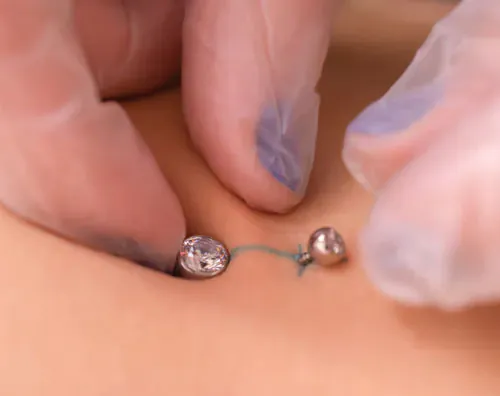
If the belly jewellery needs to be changed during the healing period, have your clients come to you so that you can do it safely.
Once the piercing has healed, piercees can change their jewellery whenever they want. This is when they can explore fun belly button jewellery options like dangles, twisted barbells, and hoops.
How much is a navel piercing?
To properly price your services, you must first ask, “How much is a belly button piercing?” Take a look at the average cost set by the studios in your area, and price accordingly. The fees you set will depend upon where you’re located; those in the cities will probably charge more than those in a more rural area.
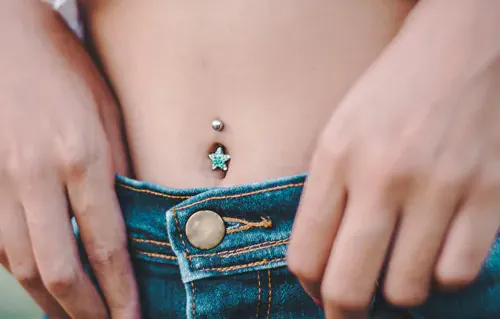
To give you an idea of how you should set your prices, a belly button piercing usually costs somewhere between £15 – £50, not including jewellery.
Belly button piercing jewellery
A great belly button jewellery collection is what’s going to entice clients into your studio. You want to make sure that you have a fantastic selection of navel jewellery to suit any style. Let’s look at some of the hottest options this year.

In terms of standard belly button jewellery, we offer tons of options, including gemstones, hearts, anodised steel, and more. We also have lots of dangle jewellery, which is perfect for summer. These include colourful gemstones, stars, and crowns.
Piercees can also choose various hoop options, like horseshoe barbells, twisted barbells, captive bead rings, and seamless hoops for something a little different.
Regular curved barbells can be worn as belly button jewellery as well, as long as they’re the correct size. They are most commonly offered in 14G, but they can be 16G as well. In terms of length, it depends on the clients preferences, but if you stock up on jewellery that’s between 8mm – 14mm, it should cover most people.
We also offer internally threaded and threadless navel jewellery, which are the preferred attachment types for body jewellery, especially for healing piercings. Externally threaded jewellery can scrape against the piercing as they’re put in and removed. Conversely, internally threaded and threadless bananas have smooth posts that glide gently on the skin.
For clients that don’t have the proper anatomy or who want to wait to get pierced, you can offer fake belly button piercing jewellery. They attach to the navel with a spring attachment, or we offer hoop options that use tension to hold onto the skin. Our fake belly button piercing jewellery selection includes dangle options, anodised hoops, and more.
Because it’s such a popular style you’re sure to get quite a few questions about the navel piercing. Ensure that you’re fully prepared and stock up on all the wholesale belly button jewellery that you need.
Publication date and/or Last Updated: September 13, 2024
Author: cesar@suprank.com
Views: 549
Copyright Holder: Acha Co., Ltd.
Company info: WholesaleBodyJewellery is owned and operated by Acha, a leading manufacturer and online supplier of piercing jewellery with more than 20 years in the industry.


