
The Vertical Labret Piercing
The Vertical Labret Piercing
The lips offer plenty of pierceable space, making them one of the most versatile piercing areas. The majority of people can get most lip piercings, which makes them popular piercing choices among those looking for something bold. The vertical labret lip piercing is one of those piercings that refuses to be ignored.
As this piercing type becomes more popular, you’ll likely see more customers asking about it in your studio. Here’s what you need to know about vertical labret piercings, jewellery, healing, and more.
What is a vertical labret piercing?
A vertical labret piercing is a lip piercing that has an entry point at the centre of the lip and an exit point beneath the lip where a standard labret piercing would be. Unlike other lip piercings, like for instance the medusa piercing, vertical labret jewellery does not appear inside the mouth. This makes it ideal for those who might have sensory issues or who are worried about the jewellery scraping against their teeth and gums.
It has gained popularity in the last few years as a more distinctive alternative to the standard labret piercing, as the placement of the jewellery on the lip creates an alluring aesthetic. Those who have fuller lips are more suited to this piercing, as thinner lips might not carry enough pierceable tissue to conduct the piercing safely. Those who cannot get the vertical labret piercing can consider a standard labret piercing filled with a seamless hoop, which will provide a similar aesthetic.
Getting pierced
Typically, the vertical labret piercing is completed by securing the lip with forceps and pushing the needle through in one smooth motion. Although vertical labret piercing pain is typically low, it goes through quite a bit of tissue, so your clients may feel a bit of apprehension before getting this piercing type. Make sure that you fully walk them through the process so that they can visualise what will happen, and apprise them of any potentially uncomfortable moments (such as feeling a bit of a pop when the piercing needle goes through the lip).
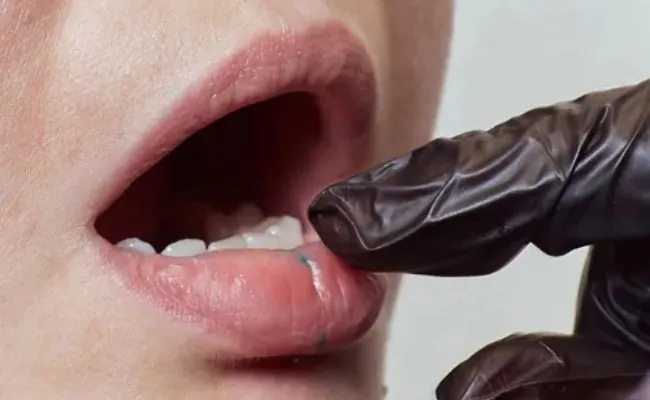
How much do vertical labret piercings hurt?
Although pain varies from person to person, many rate the vertical labret piercing at around a 4/10 on the pain scale. Because the lips are sensitive, they feel more pain than a lobe piercing, but likely no more than a cartilage piercing. Most shouldn’t feel more than a slight pinch during the piercing process. To help minimize pain, you can guide customers through breathing exercises that help reduce stress. While the piercing itself is mild, it is normal to feel discomfort in the first few days after getting pierced.
Lip piercings tend to swell more than other piercing types and come with side effects like some throbbing and discomfort while eating or chewing. To reduce pain, take over-the-counter painkillers and stick to soft foods like soups, mashed potatoes, and smoothies until the swelling goes down. Ice packs can also help mitigate pain and swelling.
How much is a vertical labret piercing?
The price of a vertical labret piercing will vary depending on where you’re located, but customers can expect to pay between £20 – £40. To accurately price your services, take into account your level of expertise as well as what other piercers in your area are charging for the vertical labret. Remember that cheaper isn’t always better; some clients might be wary of prices that are too low as it could indicate poor service.
How long do vertical labret piercings take to heal?
Although most piercers will say that the vertical labret piercing takes around 6 – 8 weeks to heal, a quick Google search will show a far larger range—sometimes upwards of 4 months. Healing times depend on a variety of factors, including the individual’s ability to heal, their adherence to aftercare practices, and the avoidance of any issues that may prolong healing. Because the vertical labret piercing appears on the bottom lip, it sees a lot of day-to-day movement that could affect the healing process. This may account for the discrepancy in average healing times.
Long story short, if everything goes right, you can expect a vertical labret piercing healing time of about two months. However, due to the location of the piercing, it’s common to see longer healing times, so you should make sure that your clients are prepared to care for their piercing for some time.
Vertical labret jewellery
Vertical labret piercing jewellery will always be a 14G or 16G curved barbell. Due to the nature of the piercing, it cannot take any other jewellery shape. However, there’s a lot of variation to be found in vertical labret jewellery, especially now that it’s become so popular.

When your clients are first pierced, they’re best off with a standard curved barbell with small bead ends that’s long enough to accommodate swelling. The small bead ends will allow the wearer to get used to the new jewellery since it can be difficult in the first few weeks to become accustomed to eating, drinking, and talking. The jewellery should either be ASTM F-136 titanium or 316L surgical steel, both of which are suitable for fresh piercings.
After a couple of weeks, have the client come back to switch their jewellery to a shorter, more flush-fit curved barbell. Once the swelling has gone down, the longer barbell is unnecessary and can actually pose a chomping risk. A shorter barbell will be much easier for the wearer to work around.
Once the piercing is healed, your clients can wear a wide range of curved barbell jewellery. Common vertical labret piercing jewellery styles include curved barbells with a standard bead end at the bottom and a gemstone or decoration on the top, dainty gemstones, colourful beads, and more. Our selection also includes internally threaded and threadless options which are safe to use on fresh piercings. We offer plenty of wholesale labret jewellery options for your clients to love. Be sure to check them out!
What gauge are vertical labret piercings?
The vertical labret piercing is usually done at 16G, but it’s not uncommon to see 14G, too. The length of the jewellery will depend upon the wearer’s anatomy. You might consider writing down each client’s jewellery specs for them so that they can easily find the right size for themselves.
Vertical labret piercing aftercare
Successful vertical labret piercing healing primarily comes down to aftercare. If the piercee keeps it clean, avoids harmful products and activities (such as chapstick or swimming in a pool or lake), and protects it from snags and snares, then their vertical labret piercing should heal as quickly as possible.
Here are some top tips for vertical labret piercing care.
- Clean it 2 – 3 times daily with a sterile-packaged saline solution.
- Keep the jewellery as still as possible for the entire healing period. This can be an extra challenge for the vertical labret piercing since it’s located at the centre of the bottom lip. Piercees should do their best to avoid licking or biting their lips, keep talking to a minimum, and abstain from absentmindedly playing with the jewellery.
- Do not use any products besides saline solution on or around the piercing during healing. This includes chapstick, lotion, tea tree oil, and more.
- Avoid spicy and acidic foods, and use mouthwash that doesn’t contain alcohol. These types of food can cause irritation in a healing piercing, and although the vertical labret piercing doesn’t appear within the mouth, it’s close enough to cause some difficulties.
- Take care when eating not to accidentally chomp on the jewellery, especially during the first few days as you’re getting used to the new piercing.
- Keep the piercing as dry as possible, and avoid pools, tubs, lakes, and other water activities. After you leave the shower, dab the piercing dry as soon as possible.
- Do not twist the jewellery or pick at any crusties. Instead, use purified water and a fresh paper towel to dampen the crusties and gently dab them away.
- Brush and floss your teeth regularly, and be sure to use nonalcoholic mouthwash during the healing period.
- Take care of your piercing as you kiss or partake in other oral activities. Ideally, you would avoid these entirely, however, if you’re unable to, then extra care must be given.

How to clean a vertical labret piercing
To clean a vertical labret piercing, all you have to do is spray a clean paper towel with sterile-packaged saline solution and gently wipe the piercing holes.
Some piercers recommend simply spraying the entry and exit holes with saline solution and letting it dry. Others may prefer a saline soak in which the piercee fills a small cup with saline solution and dips the piercing inside for a few minutes, then dabbing the piercing dry. All three methods are suitable for cleaning the vertical labret piercing.
The important part is that cleaning is done daily and that the saline solution only contains two basic ingredients: salt and purified water.
Pros and cons
As with any piercing, the vertical labret comes with the good and the bad. Part of what makes it such an alluring piercing—its location on the lip—also means that it carries a bit of a learning curve. Many piercees have reported needing to relearn how to do things such as drinking water and kissing their partner.
If you have a client that’s on the fence, you can go over some of the following pros and cons to decide if it’s worth it.
Pros:
- It offers a unique aesthetic that helps your lips to pop.
- It provides symmetry to the face, helping to pull a pierced look together.
- It’s a little more distinctive than the standard labret piercing, perfect for those seeking something unique.
- The jewellery does not appear in the mouth, avoiding any contact with teeth and gums.
Cons:
- It takes a little time to get used to. Because the jewellery sits on the bottom lip, the wearer will need to learn how to eat and drink around it. Some people have even complained about having to relearn how to kiss their partner properly. However, most people have said that once they learned how to deal with the new jewellery, this became a non-issue.
- This type of piercing might not be allowed in a professional setting.
- The healing process can be difficult for those who are prone to dry lips, as chapstick and other similar products are not allowed during the healing period.
- Those who tend to bite their lips or absentmindedly play with their lips may find the healing period challenging.

How to hide a vertical labret piercing
Unfortunately, there’s no easy way to hide the vertical labret piercing since its position on the lips is just too difficult to ignore. Even if one wears dainty jewellery or a clear piercing retainer, it’s still going to be noticed. In some instances a scarf or face mask covering the mouth can do the trick but this is just a short-term solution.
If your client needs to be able to hide their piercings for work or social events, then the vertical labret (or, really, any lip piercing) is probably not for them.
The vertical labret piercing is one of the most distinctive piercings out there. Make sure that you’re fully prepared to help your clients achieve this unique style. Now that you know everything you need, it’s time to shop wholesale vertical labret jewellery. Check out our offerings today.
Publication date and/or Last Updated: July 4, 2024
Author: cesar@suprank.com
Views: 673
Copyright Holder: Acha Co., Ltd.
Company info: WholesaleBodyJewellery is owned and operated by Acha, a leading manufacturer and online supplier of piercing jewellery with more than 20 years in the industry.


