
Set Your Clients Up for Success: The Ins and Outs of Eyebrow Piercings
The Ins and Outs of Eyebrow Piercings
Is there anything more emblematic of the punk, f-the-system lifestyle than eyebrow piercings? This iconic aesthetic goes in and out of vogue, but it always carries a characteristic rebellious attitude we love.
As such a classic piercing choice, it’s sure to be a staple in any piercing studio. Eyebrow piercings can often be the result of impulsivity, but due to their location on the face and propensity to leave a permanent mark, they’re not piercings that should be done lightly; even after the piercing has been retired, the piercee will likely carry its shadow for the rest of their life. It’s your job as a piercer to relay this and other risks so that your customers can make an educated decision about whether they truly want this legendary look.
Here’s what piercers need to know about eyebrow piercings and how to lead their customers through the piercing process.
The anatomy of an eyebrow piercing
Eyebrow piercings are actually a form of surface piercings. This means that the jewellery is forward-facing; rather than having an entry point at the front and an exit point at the back, the entrance and exit of the piercing are along the same plane.
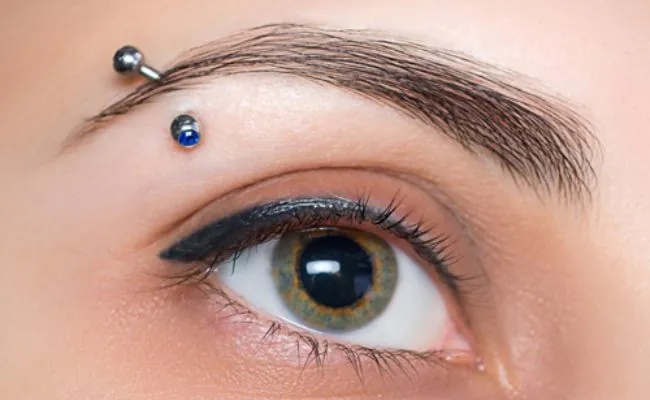
Eyebrow piercings can be placed anywhere along the eyebrow where there’s enough pliable skin, but the most common placement is toward the outer edge of the brow.
Standard eyebrow piercings are done vertically but with a slight slant.
The most aesthetically pleasing placement puts the jewellery perpendicular to the brow, but this is really up to the piercee and their anatomy. It’s always important to spend ample time determining placement with your client, but even more so with the eyebrow piercing. Not only are there loads of placement options, eyebrow piercings tend to scar, so if the client decides that they’re unhappy with the placement, they’ll likely be left with a small mark.
Eyebrow piercing variations
There are various types of eyebrow piercings besides the standard one. These styles can be perfect for those looking to create a distinct eyebrow piercing look or who don’t have suitable anatomy to conduct a standard eyebrow piercing safely.
- Double eyebrow piercing: As the name implies, this is simply two eyebrow piercings placed right next to each other. If anatomy is suitable, it may be possible to do more.
- Horizontal eyebrow piercing: You don’t have to be clever to guess that this is an eyebrow piercing that’s placed horizontally rather than vertically. It’s usually positioned right above the outer edge of the brow.
- Anti eyebrow piercing: This one isn’t really an eyebrow piercing at all, but it’s worth noting here. It’s a surface piercing that appears below the eye on the cheekbone, mirroring the eyebrow.
- Fake eyebrow piercing: If a client’s anatomy or profession precludes them from getting an eyebrow piercing, they can get fake eyebrow piercing jewellery instead. It might seem strange to stock up on fake piercing jewellery at a piercing studio, but faux jewellery can be a great way to make a sale even if the customer doesn’t have the right anatomy to get pierced.
Conducting an eyebrow piercing
When conducting an eyebrow piercing at your studio, take the proper time to ensure that the client has enough pliable skin. This is important to reduce the risk of the piercing rejecting or migrating.
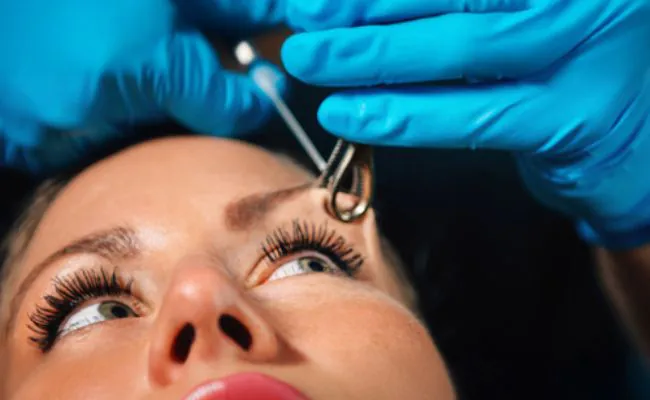
Because eyebrow piercings are surface piercings, they have a propensity to reject. Set your client up for success with secure piercing placement.
Eyebrow jewellery for initial piercings
Another way to ensure that your client’s piercing doesn’t reject is by choosing proper eyebrow jewellery. Fresh eyebrow piercings should wear lightweight curved barbells (sometimes referred to as eyebrow bars), circular barbells, or hoop styles. Since heavy jewellery can pull at the piercing holes and encourage rejection, stick to simple styles as the piercing is healing. Make sure that the initial jewellery is long enough to accommodate swelling but short enough so that it doesn’t move around too much. The most common gauge for eyebrow piercings is 16G, but 18G or 14G can be used.
Proper eyebrow jewellery material is also important. Here are the most common material choices for initial piercings.
- 316L surgical steel: Durable, non-corrosive, and hypoallergenic, surgical steel is a popular choice for initial piercings.
- ASTM F-136 titanium: Titanium is also durable, non-corrosive, and hypoallergenic, and it’s slightly lighter than steel. Furthermore, surgical steel can carry trace amounts of nickel, while titanium has none. For most people, the nickel content in steel is negligible, but it can cause a reaction in those with severe nickel sensitivities.
- 14k or 18k gold: Solid 14k or 18k gold is also suitable for fresh piercings, but it’s more expensive. For this reason, most people wait to get their first gold eyebrow jewellery piece until after their piercing has fully healed.
How much do eyebrow piercings hurt?
It’s difficult to quantify pain, as it differs for everyone. Most place eyebrow piercings at 2-5/10 on the pain scale, but you may have some clients who fare worse.
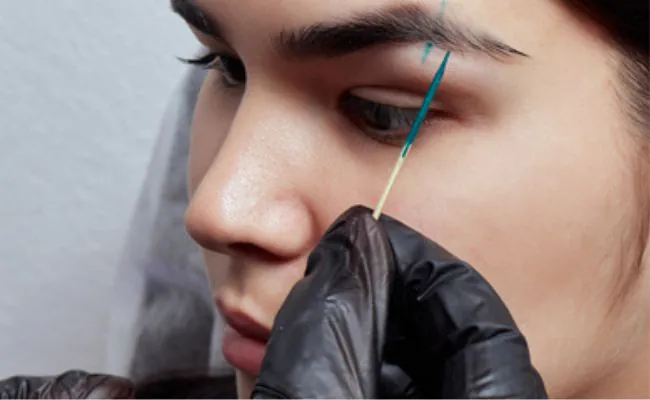
Guiding your customers through breathing exercises and walking them through the piercing process can help create a more comfortable and rewarding experience.
Eyebrow piercing aftercare
Once you’ve set your clients up for success with proper placement and fitting jewellery made of the right materials, it’s up to them to ensure that their piercing heals safely.
The most important parts of eyebrow piercing aftercare are keeping the eyebrow jewellery as still as possible throughout the entire healing period as well as cleaning it 2 – 3 times daily.
To clean an eyebrow piercing, instruct your client to always use a piercing aftercare saline solution.

There are various ways to clean a piercing. Here are some common ones:
- Spray the entry and exit holes directly with saline solution and either let it sit or gently dab it dry with a clean paper towel.
- Fill a small cup with saline solution and dip the piercing in it for a few minutes. Once done, dab it dry with a clean paper towel. This is often the preferred method for surface piercings in order to fully clean the long piercing tunnel.
- Spray a clean paper towel with saline solution and gently clean around the entry and exit holes.
Here are some tips for successful healing to pass along to your clients:
- Do not use makeup, lotion, sunscreen, or other products besides piercing aftercare on or around the piercing.
- Try to keep the eyebrow jewellery as still as possible, specially during the first few days. This means limiting eyebrow movement as much as you can.
- Takecare to avoid snagging the eyebrow bars, specially when changing clothes or doing your hair.
- Avoid hats, helmets, eyeglasses, or other items that will place pressure on the jewellery.
- Do not twist the jewellery.
- Keep the piercing dry, and avoid swimming and other water activities.
- Do not pick at crusties that form around the piercing site. Instead, use purified water to gently dampen them and dab them away with a clean paper towel.
- Avoid waxing or other such eyebrow care as your piercing heals. Instead, you can carefully pluck around the piercing site.
- If you have bangs, keep them off the piercing until it has healed, and try to wait until the piercing is healed before getting your hair done.
- Do not stop aftercare practices until your piercer has confirmed that healing is complete.
How long do eyebrow piercings take to heal?
Eyebrow piercing healing time is around 6 to 8 weeks, but some people may take a few months to fully heal. The location of the eyebrow piercing means that it’s susceptible to snags, and if your client is expressive, then the piercing will see a lot of movement. These factors can contribute to a longer healing period.
Potential risks and complications
Because eyebrow piercings are surface piercings, they carry a higher risk of rejection than most other piercing types. Because of this, it’s one of the bigger risks associated with eyebrow piercings and your clients need to be aware of this.

To avoid rejection or migration, piercees should do their best to avoid snagging their piercing jewellery and try to keep it as still as possible during the healing process.
If the eyebrow bars start to reject or migrate, there’s unfortunately nothing to be done, and the piercing must be retired. Since eyebrow piercings have a tendency to scar, it’s important that your clients know the signs of piercing rejection so that they can remove the jewellery sooner rather than later to avoid significant marks.
Signs of piercing rejection or migration include:
- Red, flaky skin around the piercing site.
- Piercing holes that have become enlarged.
- Jewellery that’s noticeably moved.
- The skin above the piercing is thinner than before.
Infection is another issue to be aware of. In most cases, infection is easily avoided through proper care; however, it can arise even if everything is done right, so it’s an important thing to watch out for. Symptoms for piercing infections include green or yellow discharge, a warm feeling around the piercing site, skin that’s swollen and inflamed, throbbing pain, or tenderness. Often, these symptoms will be severe, and they’ll arrive quickly. If an infection should form, encourage your clients to visit a medical professional immediately before it gets serious.
Eyebrow piercing jewellery
Eyebrow jewellery consists of curved barbells, (sometimes referred to as eyebrow bars, eyebrow bananas or bananabells) and various hoop styles, including seamless rings, curved barbells, and captives.
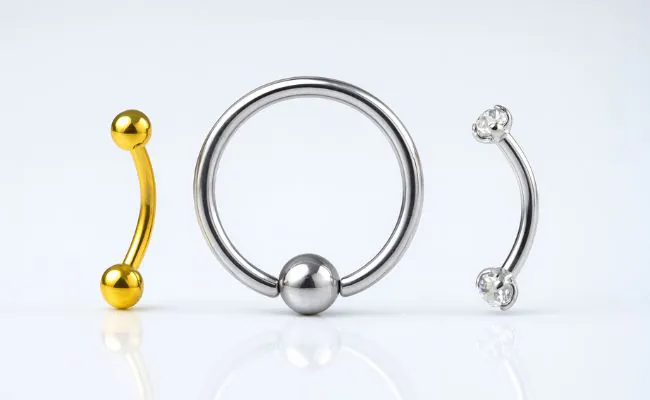
Although eyebrow jewellery for fresh piercings needs to be as lightweight as possible, once the piercing has fully healed, your customers can have a lot of fun choosing various jewellery styles made of different materials.
We carry a wide selection of jewellery suitable for eyebrow piercings. Whether your clients want the sleek sophistication of a solid 14k gold hoop, a splash of sparkly gemstones, or distinctive dangle options, we’ve got you covered! Be sure to check out our internally threaded curved barbells too.
Get wholesale eyebrow jewellery and piercing tools with Acha
Here at Acha, we care about your clients’ piercing safety as much as you do. That’s why all of our eyebrow jewellery and piercing tools adhere to UK piercing standards and undergo top levels of quality control.
Our selection includes individually packaged EO-gas sterilised jewellery and needles, offering convenience and security when conducting a piercing. Furthermore, we have a wide range of internally threaded jewellery and threadless options that are safe for initial piercings.
For piercers that double as a piercing retailer, we have a huge selection of eyebrow bars that your customers crave. We’ve been in the business for over 20 years, so you can feel secure in our offerings. Ready to learn more? Contact us today!
Publication date and/or Last Updated: November 30, 2024
Author: cesar@suprank.com
Views: 586
Copyright Holder: Acha Co., Ltd.
Company info: WholesaleBodyJewellery is owned and operated by Acha, a leading manufacturer and online supplier of piercing jewellery with more than 20 years in the industry.


