
Back to the Basics: The Complete Piercer’s Guide to Helix Piercings
Back to the Basics: The Complete Piercer’s Guide to Helix Piercings
The helix piercing is one of those classic ear piercing looks. As a piercer, you’re sure to get plenty of these requested at your studio. To help you prepare, here’s our complete guide to helix piercings, helix piercing jewellery, and piercing aftercare.
What is a helix piercing?
Helix ear piercings appear in the upper cartilage of the ear along the rim. It’s likely what piercing novices picture when they think of cartilage piercings, so if you have a client come in asking about getting their cartilage pierced, piercings for the helix could be what they’re referring to.

There are almost endless placement opportunities for the helix piercing since the upper rim of the ear offers a vast canvas.
Standard helix piercings appear just below the apex of the ear toward the outer edge, however, there are many types of helix piercings. These include forward helix ear piercings, which appear along the rim of the ear close to the head, and multiple helix piercings.
One popular look is to line the rim of the ear with many helix piercings.
Whether your clients want a standard helix piercing or forward helix piercing jewellery, this guide has you covered.
Helix piercing process
Conducting helix piercings is a pretty straightforward process. Because there are loads of piercing locations to choose from, make sure to spend extra time with your client to discuss the placement of the piercing.
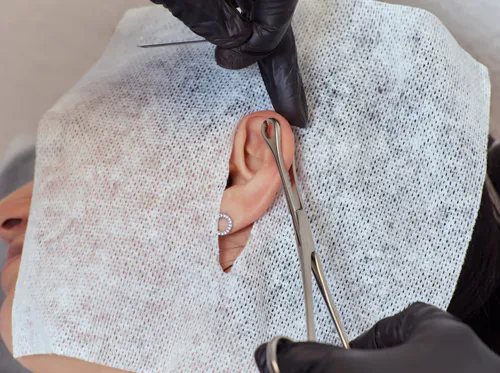
Some people might want their helix piercing to go through the actual rim of the ear, while others might want it to appear closer to the flat portion of the ear.
Ask questions and mark different areas so that you can be 100% certain that they receive the piercing that they want.
Once the area t o be pierced is marked and confirmed, you’ll perform the piercing.
Be sure to walk the client through breathing exercises to make the process a bit easier, and prepare them for some pain. Then, you’ll fill the piercing with the initial jewellery.
Initial helix piercing jewellery should be a straight bar or a flat back stud since these won’t move as much as hoops. These should be made with either 316L surgical steel or titanium G23, as these materials are biocompatible and inexpensive. Fresh helix ear piercings can wear 14k or 18k gold, however, since gold is more expensive, it’s not a popular choice for initial jewellery.
How much are helix piercings?
When setting your prices, do some market research to see what other piercers in your area charge so that you can set your rates competitively. In the UK, pricing for helix piercings can be £15 to £40, not including the jewellery.
How much do helix piercings hurt?
If your client asks, “Do helix piercings hurt?” The answer will be, “Probably.” Although individual pain levels vary, most people rank helix ear piercings as midway on the pain scale, so it’ll probably be a bit tender. Your clients can prepare by taking an over-the-counter painkiller as long as it’s not a blood thinner.
What gauge are helix piercings?
Helix ear piercings are most commonly pierced at 18G, 16G, or 14G. The length of the helix piercing jewellery will depend on the piercee’s anatomy, but it should be long enough to accommodate swelling.
Helix piercing aftercare
Just as important as the piercing process is piercing aftercare. The healing process for helix piercings is lengthy, and a lot can happen during that time that could damage the piercing.
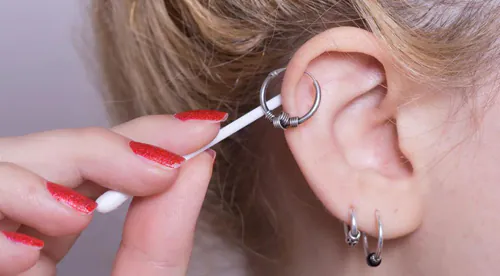
Make sure that your clients are prepared to care for their piercing for the entire healing period, and encourage them to come to you if they experience any complications.
How long do helix piercings take to heal?
Helix piercings usually take a minimum of 6 – 9 months to fully heal, although they’ve been known to take as long as a year. In some instances, it might take less than 6 months (it’s not unheard of for a helix piercing to heal completely in as little as 4 months). However, it’s incredibly common for piercees to develop issues after prematurely ending aftercare practices, so it’s best to recommend to your clients that they continue aftercare practices for at least half a year.
Encourage your clients to have you confirm that healing is complete before stopping aftercare practices, even if it’s been a year since they got pierced. Piercings always appear healed before they have fully healed internally, and it requires an expert eye to know when it’s in the all-clear.
Cleaning a helix piercing
Throughout the entire healing period, your clients will need to clean their helix piercing 2 – 3 times daily with a piercing aftercare saline solution. This can be done a few different ways, depending on preference.
- Spray the front and back of the helix piercing jewellery with the saline solution and let it sit.
- Spray a clean paper towel with saline solution and gently dab the front and back of the piercing.
- Soak a clean paper towel with saline solution, and press it against the piercing for a couple of minutes. Do this to the front and back of the piercing.
These methods should be enough to clear debris and bacteria from the piercing without irritating it or moving the jewellery around too much. Before cleaning their piercing, they should always wash their hands and try to refrain from touching the piercing as much as possible.
Helix piercing dos and don’ts
Besides cleaning the piercing, piercees need to keep the helix piercing jewellery safe throughout the healing period. This means adhering to some strict rules. Here are some dos and don’ts to pass along.
Do's
- Clean the piercing every day.
- Keep the piercing dry. When exiting the shower, use a clean paper towel to dry the piercing as soon as possible, and dab away sweat after exercising.
- Keep long hair in a ponytail, especially during the first few days of healing. This will help keep the piercing clean and free from snags.
Don’ts
- Use products besides saline solution on or around the piercing. This includes lotion, sunscreen, perfume, tea tree oil, etc. These products contain chemicals that can be harmful to the piercing.
- Go swimming or soak in a hot tub, as the piercing needs to be kept dry thoughout healing.
- Wear over-the-ear headphones, hats, or anything that presses against the piercing during healing.
- Sleep on the side with the piercing, as this places pressure on the piercing and could cause issues. If you must sleep on your side, invest in a travel pillow, and place your ear in the center where it won't be pressed upon.
- Twist the jewellery during healing. Twisting the helix piercing jewellery can damage the delicate healing tissue.
- Pick at crusties that form around the piercing. Instead, you can dampen them with purified water or saline solution and gently dab them away with a clean paper towel.
Common piercing risks
Due to the long healing time and low blood flow to the area, cartilage piercings tend to see more complications than other piercing types. Although most of these can be avoided with proper care, sometimes, they may arise even if the piercee does everything right.
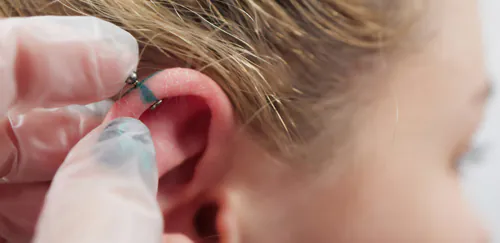
Here are the most common piercing complications to watch for and how they can be avoided.
Piercing bumps
Characterised by a small bump that appears on or near the piercing site, bumps can appear for a number of reasons, including poor cleaning practices, dampness, trauma to the piercing site, a poor choice in helix piercing jewellery materials, or just bad luck. Encourage your clients to take the utmost care when healing their helix piercing, and if a piercing bump should appear, have them come to you so that you can troubleshoot a solution depending on the type of bump.
Piercing rejection and migration
Rejection and migration in a helix piercing aren’t as common, but they can happen, so they’re worth noting. Rejection is when the jewellery is pushed out of the body, and migration is when the jewellery moves from its original piercing site. Both may occur if the piercing was improperly placed or if there was a trauma to the piercing site.
Both rejection and migration are characterised by red, flaky skin around the piercing, jewellery that’s noticeably moved, enlarged piercing holes, or skin that’s thinner above the piercing. Unfortunately, once this happens, there’s no way to stop it, and your best bet is to retire the piercing, let it heal, and re-pierce later.
Piercing infection
As long as the piercee keeps their piercing clean throughout healing, a true piercing infection should not arise. However, if a piercing infection does occur, it can be quite serious, so it’s important that your clients know the signs and when they need to visit a doctor.
Symptoms of a piercing infection include pain and swelling around the piercing site, yellow or green, smelly discharge, a feverish feeling around the piercing site, or a throbbing feeling. These symptoms often appear rapidly, and can be quite severe. If your client suspects that they have an infection, they need to seek medical attention immediately, as these can get serious rather quickly.
Hidden helix jewellery
Helix piercings and other cartilage piercings are widely accepted in many settings, even some professional ones. A couple of decades ago, piercees might have had to creatively hide their helix ear piercings in the office, but now, they can often display them proudly.

However, there may be some instances when they might still need to make their piercings more discrete. In these cases, they can invest in clear piercing retainers, dainty flat-back helix jewellery, or use their hair to hide their helix jewellery.
As always, piercings cannot be completely invisible unless you remove the jewellery, so if there are instances when the piercee must completely hide their piercing, it may be advisable to not get pierced at all.
Helix piercing jewellery
Now that we’ve gone over the technical aspects of helix piercings, it’s time for the fun bit: helix piercing jewellery.
Healed helix ear piercings can take a wide range of jewellery options, including hoops, horseshoes, spirals, flat back studs, and straight barbells.
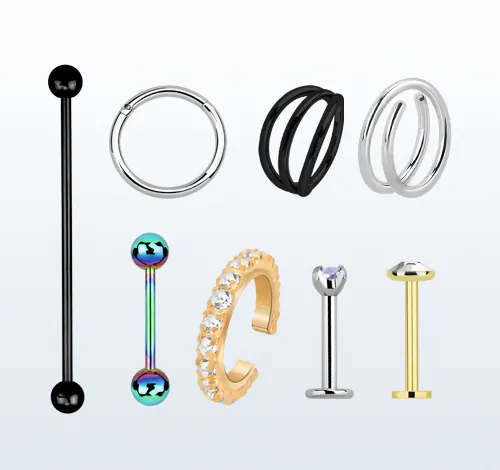
Once the helix has healed, it can also wear a range of jewellery materials, including colourful acrylic and PVD-coated options. Decorate the helix with fun designs like flowers, spikes, hearts, and more. We also carry threadless and internally threaded piercing jewellery options that exhibit high quality, safety, and a secure fit.
We offer a wide range of jewellery options, including forward helix piercing jewellery.
You can even invest in helix jewellery displays to show off your helix piercing jewellery options and entice your customers toward a sale. We work with piercing studios all over the world and offer the highest standards in quality control so that you know you’re getting the very best. Interested in learning more? Reach out to our team today.
Publication date and/or Last Updated: August 25, 2024
Author: cesar@suprank.com
Views: 574
Copyright Holder: Acha Co., Ltd.
Company info: WholesaleBodyJewellery is owned and operated by Acha, a leading manufacturer and online supplier of piercing jewellery with more than 20 years in the industry.


