
The Art of Worldly Offerings: The Ins and Outs of Importing Body Jewellery
The Art of Worldly Offerings: The Ins and Outs of Importing Body Jewellery
As you stock your piercing studio, you want to ensure that you offer trending and unique body jewellery styles at competitive prices. Although sourcing locally can provide a range of options, importing body jewellery and piercing tools opens a huge variety of possibilities that your customers can enjoy.
Importing goods comes with unique challenges, from tax considerations to shipping times. Don’t let these obstacles prevent you from providing gorgeous imported jewellery options to your customers. Here’s our guide to importing body jewellery and piercing tools and how Acha offers a simple solution for your stocking needs, plus free shipping if certain criteria are met.
Advantages of importing piercing jewellery
By importing piercing jewellery, you can offer truly unique jewellery options to your customers, blowing your competition out of the water. Besides the assortment of offerings, imported jewellery can be more cost-effective, and it diversifies your product sources so that you avoid delays if suppliers in a certain area experience complications. Let’s take a look at each of these points in more detail.
Broaden your product range
Expanding your supply chain to the global market grants access to diverse styles and materials that might not be locally available. This allows you to take advantage of global trends and offer unique products that stand out.
We live in a time when the world has become small. Between the internet and the accessibility of travel, we are more connected to other cultures than ever before. This has led to the introduction of new styles and designs inspired by cultures and aesthetics worldwide.
When you source from an overseas supplier, especially one that works with customers from all over the world, you can keep up with global trends and ensure that you have access to styles that some of your more well-travelled customers might crave.
Beyond unique and stunning designs, imported body jewellery may also come in special sizes that are difficult to find in your local market. Certain piercing types require piercing jewellery to fit perfectly in the body for optimal healing. Limited jewellery sizes might make this difficult for some anatomies. By partnering with an overseas supplier with a wide range of sizing options, you’ll be able to offer top service to all of your customers.
Avoid delays with a diversified supply chain
Location-specific supply chain delays can occur for a number of reasons that are out of your control. These range from environmental factors such as pandemics or natural disasters to geopolitical issues, labour shortages or simple policy changes.
If you’ve limited yourself to a single supplier, even if they’re local, you run the risk of supply delays due to elements outside of your control.
Therefore, it’s a good idea to diversify your supply chain with suppliers from multiple localities. This way, if one supplier has to pause services for whatever reason, you won’t be left in a lurch.
Cost efficiency
Importing piercing jewellery can decrease costs, especially if it comes from places where manufacturing costs or the acquisition of raw materials and components are low. This can lead to higher profit margins for your studio, as you can purchase items at a low cost and still price them competitively for the UK.
It’s important that you explore the social responsibility of the overseas manufacturers that you choose as your supplier. Even if manufacturing costs are low, workers should still be paid a fair wage and provided safe working conditions.
Disadvantages of importing piercing jewellery
Although importing jewellery makes perfect sense as a long-term strategy, especially in terms of cost savings and the diversity of offerings, importing piercing jewellery from overseas may come with some disadvantages.

Luckily, there are plenty of ways to mitigate these challenges so that it’s not any more difficult than sourcing locally.
Complex regulatory environment
Compliance with international standards, safety regulations, and different requirements can pose a challenge when importing piercing jewellery. You must thoroughly research your supplier to ensure that they comply with the UK’s regulations on jewellery material (which we talk more about below) and that their products align with piercing best practices.
Seek out suppliers that are transparent about their jewellery materials. They should also have experience working with UK clients so they understand the intricacies of importing piercing tools and jewellery into the UK.
Sterilised products are often a concern of UK piercers, as they require certifications to comply with local regulations. The overseas supplier that you partner with must be able to provide documentation that proves their sterilised items comply with UK law, just like we do here.
Possible shipping delays
Although shipping delays can occur with local suppliers, the longer shipping distances create more opportunities for setbacks. These can include natural disasters, political events, and more. To avoid stalled shipping, choose an overseas supplier that offers multiple shipping options, has a knowledgeable staff to help you navigate potential delays, and provides guarantees such as full refunds if the order is unable to be shipped.
Quality assurance
When investing in a new overseas jewellery supplier, you might have concerns about whether their jewellery fits your high standards, and you might not have the resources to travel abroad and see for yourself.
Rather than simply trusting that a new supplier offers the products that they claim, find one that is willing to provide free samples so that you can view its products firsthand to see if they adhere to your standards. Beyond samples, you can take a look at reviews and request professional references from their past customers.
Challenges to look out for when importing into the UK
Now that we’ve covered a general overview of considerations when shipping from overseas, let’s dive into the specific challenges of importing into the UK.
As with every country, the UK has its own regulatory requirements and logistical considerations that you should be aware of before investing in an overseas supplier.

Regulatory compliance
When importing jewellery into the UK, you have to make sure that it complies with local law. There are a few specific rules to be aware of. Make sure that the jewellery that you buy adheres to these rules to avoid any issues at customs and possible delays.
- Nickel Regulations: As per The Dangerous Substances and Preparations (Nickel) (Safety) Regulations 2005, jewellery cannot have a nickel release rate of more than 0.5cm micrograms per square centimetre per week. This is to prevent allergic reactions.
- Hallmarking: Precious metals, such as gold, must be hallmarked according to the UK’s Hallmarking Act. This means that it must carry proof, as outlined in this act, that the precious metal is of a certain grade and quality.
- Consumer Rights Act: This act requires goods sold in the UK to be fit for purchase and of satisfactory quality. It holds the seller accountable, so you must ensure that the items that you purchase from overseas are as advertised before you advertise and sell them to your customers.
- Sterilisation: As part of the UK’s Regulation of Tattoo and Body Piercing Business, all piercing equipment must be sterilised or single-use.
Customs and import duties
Jewellery importations are subject to duty and VAT. In the UK, you can expect a duty fee of 2.5% and VAT of 20%. It’s important to remember that, even though you must pay VAT for import goods, the overall cost is still cheaper than purchasing local jewellery and piercing tools, due to the low initial cost.
Currency fluctuations
As of 2024, the GBP has fluctuated in value. This is something to keep in mind when purchasing from overseas, as you may notice some differences in price as the GBP value changes.
Navigating customs clearance
To avoid potential delays when importing goods from overseas, you must make sure that your goods are compliant with import regulations. Here are our top tips for navigating customs clearance and ensuring that you receive your shipment on time.

Understand import regulations
Before importing, familiarise yourself with the UK’s import regulations and ensure that the jewellery meets the required standards, including any new or upcoming changes to the laws. If this seems like a lot of work to receive a jewellery shipment, partner with an overseas supplier that has a proven track record of working with UK-based piercing studios and can guide you through the process.
Documentation and compliance
When importing goods from overseas, you must provide the correct documentation to prove regulatory compliance. Failure to provide the proper documentation could result in goods seizure and delays.
- Hallmarking: You must ensure that any precious metals carry the proper certification to prove their quality.
- EORI number: Businesses that accept imported goods must carry an EORI number which will identify your business. It’s required to fill out customs forms.
- Import licenses: Your supplier must show that they can export from their country and import into the UK
- Customs declaration: When importing goods into the UK, you must fill out a customs declaration that includes the commodity code, the value of the goods, etc.
To make sure that you’re fully equipped with all of the documentation you need to receive imported goods, here is a guide from the UK government outlining exactly what documentation you need to receive imported goods.
Plan for inspection possibilities
Imported goods are susceptible to inspections. These can be random, but they may also occur if your shipment has been flagged for whatever reason. You can reduce the risk of being flagged by ensuring that you have all of the proper documentation for importation and that the supplier you choose adheres to UK regulations for jewellery imports. To account for delays from random inspections, make sure that you build some buffer time when you make your order.
Insurance
No matter how reliable your overseas supplier is, there are always risks when moving goods across the world. Invest in insurance to protect yourself against loss, damage, or fees associated with transport. This will provide some peace of mind, even if your supplier is solid.
Other things to consider
Importing jewellery from abroad requires more than logistical considerations. You must ensure that your suppliers are ethical, that you practice cultural sensitivity, and that you’re aware of your supply chain sustainability.

Supplier platforms
It is recommended to make use of tools that can help you manage your overseas supply chains. These include things like customs duty calculators, supply chain management software, and ESG data collection that integrates with your supply chains to gain insight into how your suppliers affect your environmental footprint.
Using the right tools can improve business performance by streamlining efficiency and reducing costs, alleviate risks and minimise supply chain disruptions.
In terms of social responsibility, you must ensure that the suppliers you use exhibit safe working conditions and fair labour practices. It’s possible to enjoy low manufacturing costs without exploiting human labour.
Shipping costs to the UK
Shipping costs depend on the shipping type, volume of goods, and how quickly it needs to be delivered. (Side note: in some instances, Acha can provide free shipping. Reach out to learn more.)

When choosing a shipping type, here are some considerations beyond cost:
- Sea freight results in a lower carbon footprint than air freight.
- On the other hand, air freight is often faster, more secure, and streamlined.
- Courier services often have great customer service, which is why we recommend them to our customers.
Air freight
- Cost: This is generally the most expensive option, but costs can vary. For example, shipping a small package can range from $5 to $15 per kilogram.
- Best for: Urgent, high-value, or lightweight shipments.
Sea freight
- Cost: More cost-effective for larger shipments, with prices typically charged per container. For less-than-container loads (LCL), costs might range from $50 to $100 per cubic meter.
- Best for: Heavy or bulky shipments not required urgently.
Courier services
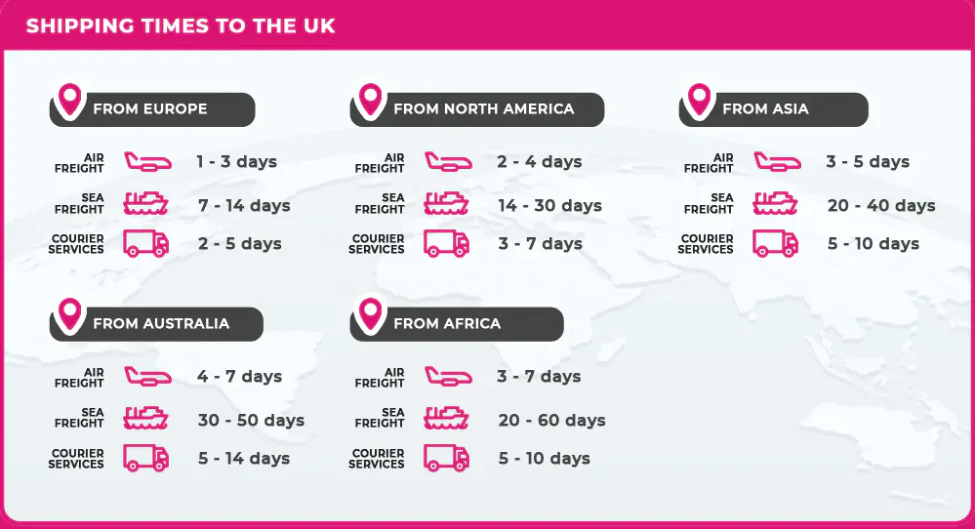
- Cost: Rates depend on the service provider (e.g., DHL, FedEx, UPS) and the package’s dimensions and weight. Prices could start from as little as $20 for small packages using economy services. Here are our estimated rates of shipping.
- Best for: Small to medium-sized packages that need relatively fast delivery.
Importing body jewellery with Acha
If importing body jewellery and piercing tools seems overwhelming, Acha makes it easy for you. Not only do we offer all of the advantages of importing jewellery—cost savings, diverse offerings, etc.—but we also have a knowledgeable sales team with tons of experience working with UK-based piercing studios who will help guide you through the process.
We’ve been in business for over 20 years and know how to navigate the complicated world of importation. Even if it’s your first time buying wholesale jewellery from overseas, we can guide you through the process for a stress-free experience. Additionally, we’ll replace any shipment that gets lost or damaged during transit, and we carry a money-back guarantee if you’re unsatisfied with your purchase.
We partner with multiple couriers so that you can choose the service that works best for your studio. All in all, you’d be hard-pressed to find a more seamless overseas shipping experience.
We know that shipping costs can be a burden. That’s why, as part of our commitment to provide the best service, we offer free shipping for orders of a certain amount. Visit our website for more details.
Conclusion
Importing jewellery comes with its challenges, but with the proper documentation and partnership with the right supplier, it’s just as easy and more cost-effective than sourcing locally. Acha can be the perfect solution so that your piercing studio can enjoy a wide selection of cost-effective jewellery designs and an easy import experience.
Want to learn more? Contact us today!
Publication date and/or Last Updated: August 19, 2024
Author: cesar@suprank.com
Views: 517
Copyright Holder: Acha Co., Ltd.
Company info: WholesaleBodyJewellery is owned and operated by Acha, a leading manufacturer and online supplier of piercing jewellery with more than 20 years in the industry.


